Borevo Borevo

Top Global AI Server Manufacturers

Time:2026-09-27 Author:Madeline
0%

The global ai server manufacturers market is reshaping the infrastructure behind modern computing. Its products now support generative AI, scientific modeling, medical research, and industrial automation. Behind every polished chatbot is a physical system: GPU trays, high-speed networking, liquid-cooling loops, and dense storage racks.

This article examines leading manufacturers, including Dell Technologies, HPE, Lenovo, Supermicro, Inspur, and GIGABYTE. It compares their platforms through practical criteria: accelerator support, thermal design, deployment speed, software compatibility, service coverage, and long-term operating costs. These details matter. A server can appear powerful on paper yet struggle in a crowded data center with limited electricity or cooling capacity.

NVIDIA CEO Jensen Huang has repeatedly emphasized the importance of accelerated computing, stating, “The future of computing is accelerated computing.” His view helps explain why AI servers differ from conventional enterprise machines. They require faster interconnects, larger memory pools, and more careful power planning. They also demand experienced technicians.

The strongest manufacturer is not identical for every buyer. A research laboratory may value maximum GPU density, while a regional cloud provider may prioritize serviceability and predictable supply. That distinction is easy to miss. Market rankings can also change quickly because chip access, energy prices, and export rules continue to influence purchasing decisions.

This overview aims to remain evidence-led and practical. It does not treat brand reputation as proof. Specifications must be checked against real workloads, verified customer support, and measured performance. Some conclusions may age quickly. That is an unavoidable weakness in this fast-moving industry.
Top Global AI Server Manufacturers

Definition and Role of AI Server Manufacturers

Top Global AI Server Manufacturers

Definition and Role of AI Server Manufacturers

AI server manufacturers design and assemble systems built to train or run demanding AI workloads. A typical system combines accelerators, processors, high-speed memory, networking, power delivery, and thermal management. Their role extends beyond putting components in a chassis: they test system stability, airflow, and performance under sustained load. Some also provide deployment guidance and maintenance. They do not necessarily manufacture every component they integrate.

Demand is growing quickly. IDC’s 2024 Worldwide AI and Generative AI Spending Guide projected global AI spending would reach nearly $632 billion by 2028, with a 29% compound annual growth rate. That forecast covers more than servers, but it signals the wider investment driving infrastructure needs. Buyers should compare measured workload performance, power use, cooling requirements, and service coverage—not accelerator counts alone. “AI server” can describe very different configurations. That matters.

Tips: Ask for test results under your own workload, including power draw and sustained temperature. Check rack space and cooling needs before ordering. A specification sheet rarely tells the whole story.

AI Server Manufacturers: Definition, Role & Data-Center Energy Context

Global data-center electricity consumption (including servers, storage, networking, and cooling), in terawatt-hours (TWh)

What manufacturers do: AI server manufacturers design and assemble compute systems that combine accelerators, processors, memory, networking, and power and cooling components. These systems support AI training and inference. The figures provide broader infrastructure context; they are not an estimate of AI servers’ individual energy use. The 2026 values are IEA low- and high-demand scenarios, not observed results.

Source: International Energy Agency (IEA), Electricity 2024. 2022: approximately 460 TWh; 2026 scenarios: 620–1,050 TWh.

Key Technologies Used in AI Server Production

AI server production depends on coordinating processors, memory, power, and cooling inside a dense chassis. Accelerator boards may draw substantial power, so engineers design power-distribution systems to deliver stable current with minimal loss. High-bandwidth memory keeps data close to compute units, while fast board-level links help processors exchange data without unnecessary delays. Fast links matter.

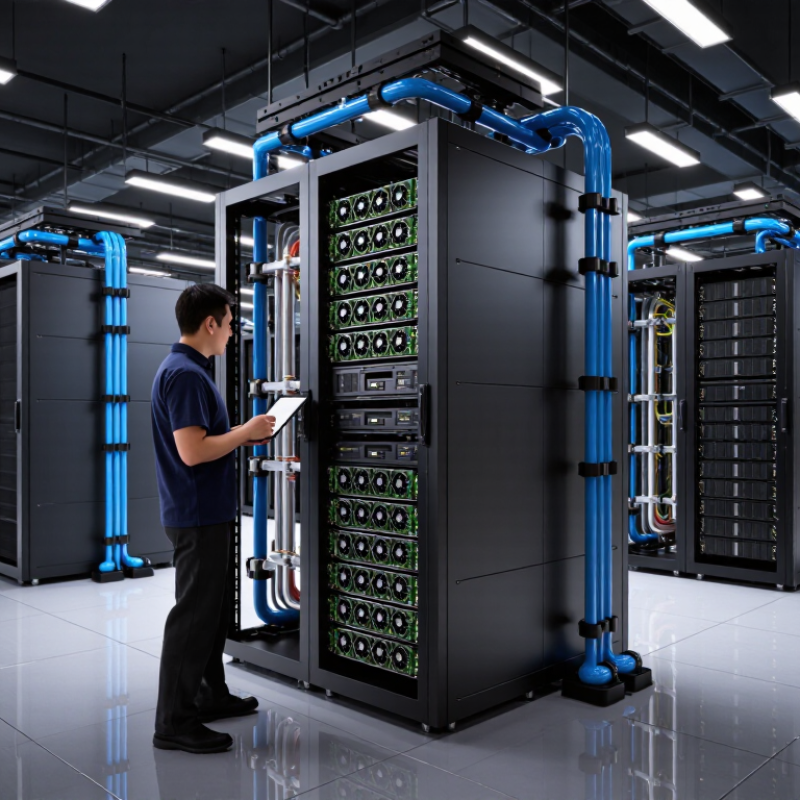
Thermal design is just as important. Cold plates and liquid-cooling loops can remove heat directly from processors, while carefully placed fans move air across memory and power components. Sensors track temperatures at multiple points, allowing control systems to adjust fan speeds or reduce workloads when needed. Heat is relentless. Yet liquid cooling adds plumbing, seals, and maintenance requirements; it is not automatically the best choice for every data center.

Manufacturers also rely on firmware, automated assembly, and extensive validation. Technicians inspect board connections, check power delivery, and run sustained workloads to reveal instability that brief tests can miss. Small details count. Cable routing, connector seating, and airflow gaps can affect reliability in a tightly packed rack. Testing still cannot predict every operating condition, so field feedback should inform later design revisions. That feedback loop is often less tidy than a production plan suggests.

Top Global AI Server Manufacturers - Key Technologies Used in AI Server Production
Technology Area How It Is Used in AI Servers Production and Design Considerations Role in AI Workloads
GPU and AI Accelerator Integration Servers combine multiple accelerator devices with host processors, memory, storage, and high-speed interconnects. Board layout, power delivery, airflow, and device placement must account for high component power and dense configurations. Provides parallel computing capacity for model training, inference, and other machine-learning workloads.
High-Bandwidth Memory High-bandwidth memory is commonly integrated close to accelerator compute units, often within the same package. Package design and thermal management are important because memory and compute components operate in a compact space. Supplies data to accelerators at high bandwidth, helping reduce memory bottlenecks in large workloads.
Scale-Up Interconnects High-speed links connect accelerators within a server so they can exchange data and coordinate computation. Signal integrity, topology, cabling or board routing, and link testing are key design and manufacturing concerns. Enables multi-accelerator systems to handle larger models and distribute computation across devices.
Host and Expansion Interfaces PCI Express connects processors, accelerators, network adapters, and storage devices. Compute Express Link can support coherent memory and device connectivity in compatible systems. Designs must match interface generations, lane counts, slot layouts, and supported device configurations. Connects major system components and supports flexible configurations for different workloads.
High-Speed Networking Ethernet-based fabrics and other high-speed network fabrics connect servers in AI clusters. Remote direct memory access can reduce CPU involvement in data transfers when supported. Network adapter placement, port density, cabling, and system-level throughput testing affect cluster performance. Moves training data and model traffic between servers and storage systems.
Power Delivery High-capacity power supplies and carefully designed power distribution deliver electricity to processors, accelerators, memory, and fans or pumps. Manufacturers validate power budgets, transient response, redundancy, connector ratings, and electrical safety. Maintains stable operation under the demanding and variable power loads of AI workloads.
Advanced Thermal Management Air cooling, direct-to-chip liquid cooling, and facility-level heat-rejection systems are used according to system density and deployment requirements. Thermal design includes airflow paths or coolant loops, leak detection where applicable, service access, and temperature validation. Controls component temperatures and helps sustain performance during prolonged computation.
Dense Chassis and Rack Integration AI servers are designed for rack deployment, with attention to server dimensions, cabling, power connections, and cooling infrastructure. Mechanical strength, airflow clearance, weight distribution, and maintainability are checked during system integration. Allows compute, networking, and cooling resources to be deployed efficiently in data centers.
Firmware and Platform Management System firmware and management controllers monitor hardware status, support remote administration, and report faults. Production testing checks firmware versions, sensor readings, boot behavior, update processes, and management interfaces. Supports system operation, diagnostics, maintenance, and fleet-level monitoring.
Manufacturing Validation Completed systems undergo hardware inspection, firmware checks, stress testing, and functional testing before shipment. Test plans typically verify component detection, memory and storage operation, network connectivity, power behavior, and thermal response. Helps identify assembly or configuration issues before servers enter production environments.

Leading Global AI Server Manufacturers by Market Region

Market Structure AI server manufacturing is a regional network, not a simple country-by-country ranking. North American manufacturers and integrators often focus on system architecture, customer-specific configurations, and deployment support. East Asian suppliers are especially important in high-volume assembly and component integration. European producers often emphasize customized systems, energy efficiency, and local data-center requirements. These are broad patterns; individual capabilities vary.

Market Momentum Demand is rising quickly. IDC reported worldwide server revenue of $77.3 billion in the fourth quarter of 2024, up 91.3% year over year. TrendForce forecast AI server shipments of about 1.67 million units for 2024, a 41.5% annual increase. These figures describe a fast-changing market, not the market share of any particular region. The supply chain is not perfectly neat: design, board production, assembly, and testing may happen in different places.

Tips: Compare manufacturers by delivery lead time, thermal design, service coverage, and support for your preferred accelerator platform. Ask where systems are assembled and tested. A low purchase price can hide cooling or maintenance costs. Check the details.

How AI Server Makers Differ in Design and Performance

Top Global AI Server Manufacturers

How AI Server Makers Differ in Design and Performance

AI server makers differ less by headline specifications than by how systems balance compute, power, cooling, and serviceability. A dense rack can hold many accelerators, yet performance depends on feeding them data without bottlenecks. Fast links between processors, capable memory, and well-planned storage paths matter as much as raw chip counts. Engineers should compare complete configurations, not isolated component numbers. Short benchmarks can mislead.

Cooling choices create visible design differences. Air-cooled systems may suit existing rooms, while liquid cooling can support higher heat loads in compact racks. But pumps, manifolds, and maintenance access add complexity. Small details matter. Cable routing, replaceable fans, and clear service procedures can reduce downtime during continuous operation. A design that looks efficient on paper may be awkward to repair.

Performance also changes with workload. Model training often benefits from fast accelerator communication and sustained power delivery. Inference may favor memory capacity, predictable latency, and efficient handling of many requests. Buyers should request measured results using relevant software, realistic data, and sustained runs, then check power and temperature at the rack level. I would not treat one test score as a verdict. Workloads shift, and even careful evaluations leave some uncertainty.

Industry Trends Shaping the Global AI Server Market

AI server demand is moving beyond raw processing speed. Training and inference workloads now rely on dense accelerators, fast memory, and high-bandwidth links between nodes. A single rack can draw far more power than a conventional computing rack, making electrical capacity a design constraint. Cooling matters just as much. Liquid systems can remove heat efficiently, but they require careful attention to plumbing, monitoring, and maintenance access.

That is changing how facilities and equipment are planned. Buyers increasingly compare performance per watt, rack density, and total operating costs, not just processor counts. Shorter deployment cycles also favor modular designs that let teams add capacity in stages. Supply chains remain uneven, though, and specialized components can delay otherwise ready projects. Forecasts can make growth seem smooth; actual installation schedules rarely are. That gap deserves more attention. Operators must also check how new systems fit existing network fabrics and service procedures. A fast server is less useful when storage, power delivery, or cooling becomes the bottleneck. These trade-offs vary by workload, location, and facility age. A practical evaluation starts with measured demand and realistic site limits, rather than peak specifications alone.

FAQS

What technologies are central to AI server production?

Processors, high-bandwidth memory, fast board links, and stable power systems work together. Small details matter.

How do servers keep processors cool?

Cold plates and liquid loops remove heat directly, while fans cool memory and power components. Heat is relentless.

Is liquid cooling always the best option?

No. It can handle high heat loads, but pumps, seals, plumbing, and maintenance add complexity. The fit depends on the data center.

Why do cable routing and connector seating matter?

Poor routing or loose connections can affect airflow and reliability inside a packed rack. Easy to overlook.

How should buyers compare AI server performance?

Compare complete configurations, including processors, memory, storage paths, cooling, and power. Chip counts alone can mislead.

Do training and inference need the same server design?

Not always. Training often needs fast accelerator links and sustained power; inference may need more memory and predictable latency.

What should performance testing include?

Use relevant software and realistic data, then run sustained workloads. Check rack-level power and temperature too.

Can factory testing guarantee reliable operation?

No. Inspections and long tests can reveal instability, but real operating conditions still vary. Field feedback should guide revisions.

Conclusion

AI server manufacturers design and produce specialized computing systems that support demanding artificial intelligence workloads, from model training to real-time inference. Their products combine high-performance processors and accelerators with fast memory, advanced networking, efficient power delivery, and thermal management. These technologies help servers process large datasets reliably while balancing speed, capacity, energy use, and operating costs.

Across global markets, global ai server manufacturers differ in how they configure hardware, scale systems, and prioritize performance, flexibility, and efficiency. Some designs emphasize dense computing for large-scale data centers, while others focus on adaptable platforms for varied workloads. The industry continues to evolve as AI applications grow, prompting ongoing advances in cooling, system integration, energy efficiency, and infrastructure scalability. These trends are shaping how manufacturers meet rising demand while helping organizations build dependable computing environments.

Madeline

Madeline

Madeline is a dedicated marketing professional with a wealth of expertise in our company's core offerings. With a keen understanding of the industry, she brings a unique perspective to her role, consistently delivering high-quality content that highlights the superior aspects of our products. As......