 Borevo
Choosing the best industrial AI server manufacturer in China requires more than comparing processor counts or promotional benchmarks. A reliable decision begins with actual factory conditions: continuous workloads, dusty environments, strict cooling demands, and limited maintenance windows. A server may look powerful in a laboratory yet struggle beside a production line. That gap matters.
Jensen Huang, NVIDIA’s founder and CEO, has described AI as “the most powerful technology force of our time.” His observation highlights a practical reality: industrial AI hardware must convert computing power into dependable results. This article examines leading Chinese manufacturers through that lens. It considers GPU compatibility, thermal design, ECC memory, storage performance, remote management, supply stability, technical support, and lifecycle costs. It also asks whether each supplier can support computer vision, predictive maintenance, digital twins, and edge inference at scale.
No single company wins every requirement. That assumption deserves scrutiny. A manufacturer with strong domestic service coverage may not offer the best global documentation. Another may deliver excellent computing density but provide weaker customization. Some systems perform well initially, then reveal limitations through noisy cooling, firmware delays, or difficult repairs.
The comparison therefore focuses on evidence, not slogans. It looks at deployment experience, measurable specifications, customer support, and long-term reliability. Readers will find a practical framework for identifying the best industrial AI server manufacturer for their workload, budget, and operating environment. The answer may be less tidy than expected. That is precisely why careful evaluation is necessary.
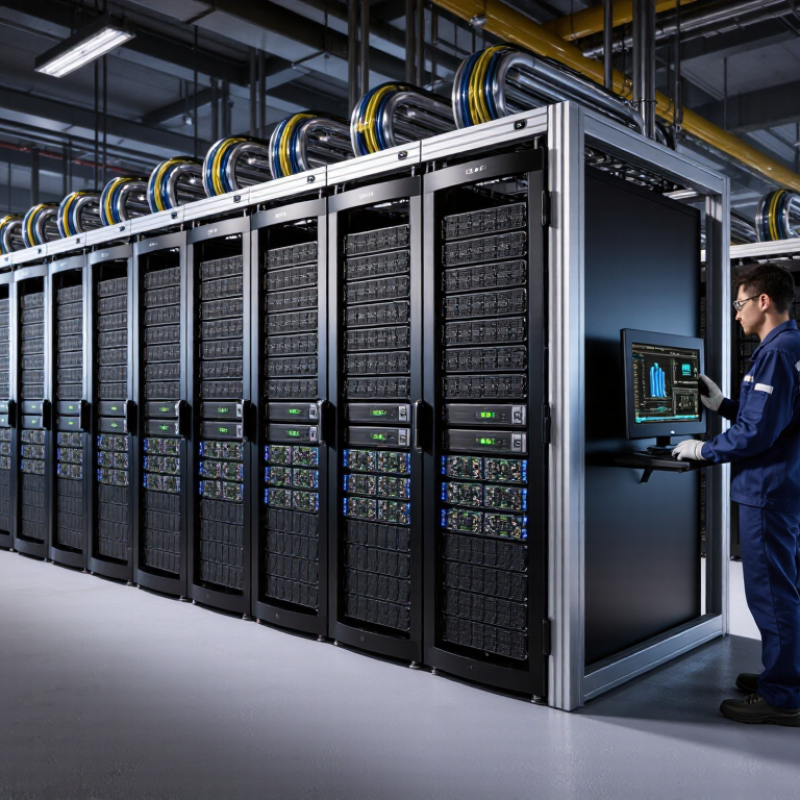
China’s AI server market is moving from pilot projects to factory-floor deployment. IDC’s 2024 China AI Server Market Forecast indicates annual market growth above 20%, supported by generative AI, industrial vision, and intelligent manufacturing. IDC also expects demand to remain strong through 2028.
This growth changes how buyers should judge the best industrial AI server manufacturer. Peak benchmark scores are not enough. A reliable supplier should provide stable GPU supply, redundant power, efficient cooling, and remote fault monitoring. In a dusty workshop, a server may face heat, vibration, and continuous workloads. These details matter more than a short laboratory test. The China Academy of Information and Communications Technology reported continued expansion in intelligent computing capacity during 2024. However, forecasts remain estimates, not guarantees. Electricity costs, component access, and local deployment policies can alter purchasing plans quickly.
Tips: Ask for thermal test records, workload-based benchmarks, and repair-response data. Request a 72-hour stress test using your own vision or simulation software. Check whether the manufacturer supports Linux, common AI frameworks, and secure on-site maintenance. A lower purchase price can become expensive when downtime reaches several hours. IDC’s forecast is useful, but each factory still needs its own power, cooling, and service calculation.
| Evaluation Dimension | Market Indicator | Verified Data Point | Implication for Industrial AI Server Selection |
|---|---|---|---|
| China AI server market growth | IDC 2024 market outlook | Double-digit annual growth expected | Manufacturers should provide scalable product families, stable supply capacity, and upgrade paths for rapidly expanding AI workloads. |
| AI computing demand | Training and inference workloads | Demand is shifting toward both training and inference | The preferred supplier should support GPU acceleration, high-speed interconnects, large memory configurations, and optimized inference deployment. |
| Industrial automation | China industrial robot production | More than 400,000 units produced in 2023 | Industrial AI servers need reliable real-time processing for machine vision, robotics, predictive maintenance, and production-line control. |
| Manufacturing AI applications | Typical use cases | Vision inspection, digital twins, quality prediction | Systems should support multi-camera input, high-throughput video analytics, containerized applications, and integration with factory software. |
| Edge AI deployment | Factory-floor computing requirements | Low-latency processing is increasingly important | Compact industrial servers should offer short response times, wide-temperature operation, remote management, and resistance to dust and vibration. |
| Network infrastructure | China 5G infrastructure scale | More than 4 million 5G base stations by the end of 2024 | Industrial AI server platforms should support distributed deployments, high-bandwidth data transfer, private networks, and centralized remote monitoring. |
| Compute density | Accelerated computing requirement | Multi-accelerator configurations are increasingly common | Evaluation should include thermal design, power delivery, rack density, PCIe expansion, and sustained performance under continuous workloads. |
| Data storage and throughput | Industrial video and sensor data | High-volume, mixed-format data processing | A suitable platform should provide fast NVMe storage, redundant storage options, high-speed networking, and flexible data-protection policies. |
| Reliability and availability | Continuous production operations | 24/7 operation is a core industrial requirement | Key selection criteria include redundant power supplies, ECC memory, hot-swappable components, predictive monitoring, and long-term spare-parts support. |
| Software compatibility | AI development and deployment stack | Linux, containers, virtualization, and mainstream AI frameworks | The manufacturer should document support for common operating systems, container platforms, orchestration tools, model-serving software, and enterprise APIs. |
| Energy efficiency | Data-center and factory operating costs | Power efficiency is a major total-cost factor | Compare performance per watt, cooling requirements, power-management features, utilization monitoring, and the estimated three-to-five-year operating cost. |
| Domestic service capability | Industrial deployment support | On-site response and lifecycle support are critical | The strongest supplier profile includes nationwide service coverage, installation assistance, firmware maintenance, remote diagnostics, and defined service-level agreements. |
| Supply-chain resilience | Procurement and component availability | Long-term availability should be assessed before deployment | Buyers should request component lifecycle information, alternative configuration options, delivery lead times, and a continuity plan for critical parts. |
| Best-fit manufacturer profile | Overall industrial AI suitability | Reliable, scalable, serviceable, and workload-matched | The best manufacturer is not determined by compute specifications alone; it should demonstrate validated industrial deployments, predictable performance, strong support, and transparent lifecycle costs. |
Demand is moving from pilot projects to factory-floor deployment. Generative AI, industrial vision, and smart manufacturing support this growth. Forecasts suggest strong demand through 2028, but forecasts can change.
Check sustained performance, power stability, cooling, remote monitoring, and repair response. Short laboratory results may hide factory problems. Real workloads matter more.
Use the same model, dataset, batch size, and power limit. Measure latency, accuracy, and performance after several hours. A 72-hour stress test reveals more.
FP8 performance indicates speed for reduced-precision AI workloads. Results depend on software, model size, and batch settings. A high score is not proof of practical superiority.
High bandwidth helps move large tensors quickly between memory and computing units. Capacity matters when models grow. Fast memory cannot compensate for insufficient space.
It signals significant power and heat demand, not guaranteed speed. Buyers should inspect airflow, power delivery, fan noise, and long-term stability. Heat needs somewhere to go.
Include hardware, electricity, cooling, maintenance, downtime, and replacement parts. A continuously operating 1.2 kW server may use over 52,000 kWh in five years. Cooling adds more.
Confirm coverage for GPUs, storage, power supplies, and on-site labor. Ask about response times, spare parts, remote diagnosis, and escalation procedures. A long warranty can still disappoint.
Dust, vibration, heat, rack airflow, and continuous workloads can shorten component life. Electricity prices and local policies may also change plans. I once focused too much on headline scores; that was a mistake.
China’s industrial AI server market is expanding rapidly, driven by demand for intelligent manufacturing, energy management, logistics, and large-scale data processing. Selecting the best industrial ai server manufacturer requires more than comparing purchase prices. Buyers should evaluate FP8 performance, HBM bandwidth, and support for high-power GPUs with TDPs of up to 700W. These specifications influence model-training speed, inference efficiency, system scalability, and cooling requirements.
A reliable supplier should also demonstrate strong quality control, ISO 9001 certification, uptime-oriented infrastructure design, and competitive MLPerf results. A complete five-year total cost of ownership analysis should include energy consumption, cooling, maintenance, warranty coverage, software compatibility, and technical support. The most suitable solution is therefore the one that balances performance, reliability, expansion capability, operating efficiency, and long-term service quality for specific industrial workloads.
