Borevo
The 2026 AI server market is entering a more demanding phase. Cloud providers want faster deployment, higher rack density, and lower power consumption. These pressures are reshaping the global supply chain.
TrendForce reported that AI server shipments were expected to grow by about 28% year over year in 2025. It also estimated that AI servers could exceed 15% of total server shipments. Dell’Oro Group has similarly identified accelerated computing as a major driver of data center infrastructure investment. These figures suggest strong momentum, but they do not tell the whole story. Regional production capacity, advanced cooling, networking design, and component access matter just as much.
The stakes are enormous.
NVIDIA CEO Jensen Huang, one of the most influential voices in AI infrastructure, said at GTC 2024, “The next industrial revolution has begun.” His statement captures the shift from conventional data centers toward AI factories built around dense computing systems.
This guide examines the leading ai server manufacturing company candidates for 2026. It considers manufacturing scale, GPU integration, supply-chain resilience, energy efficiency, and enterprise deployment experience. Companies such as Dell Technologies, Hewlett Packard Enterprise, Lenovo, Supermicro, Inspur, and Quanta deserve close attention. However, rankings remain difficult. Public revenue figures often combine AI servers with broader hardware businesses. Some comparisons may therefore look precise while hiding important gaps.
The strongest manufacturers will not simply ship more servers. They will deliver complete systems that operate reliably under extreme heat, power demand, and workload volatility. That distinction may separate market leaders from fast-growing suppliers.
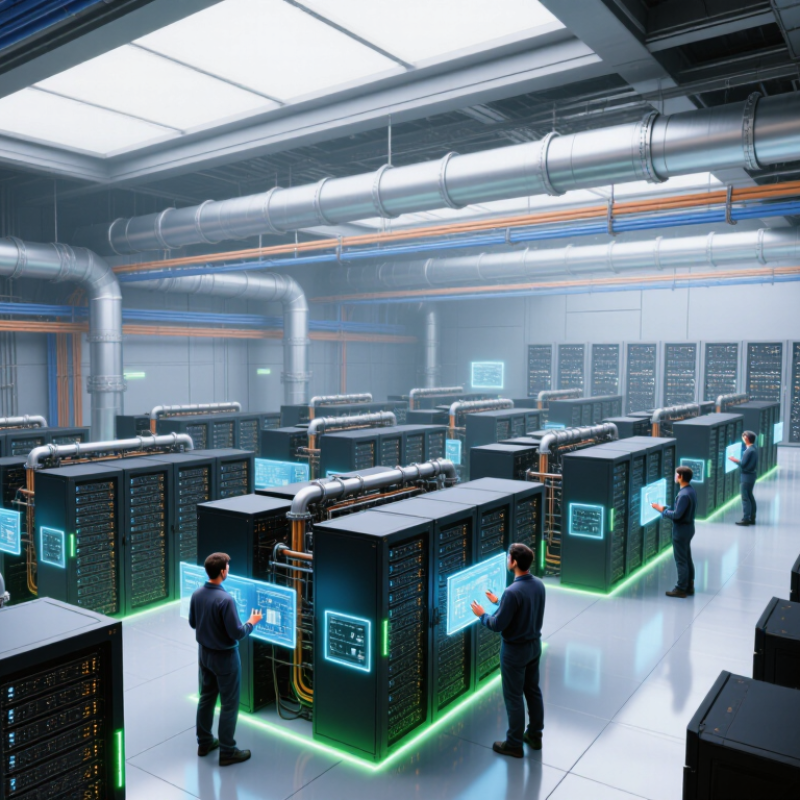
AI server manufacturing in 2026 covers more than assembling racks with powerful processors. It includes designing, integrating, testing, and supporting systems built for machine learning, high-performance computing, and real-time analytics. A complete server may combine accelerator modules, general-purpose processors, high-speed memory, storage, networking, and advanced cooling. Power delivery also matters. Quietly, it determines whether dense equipment remains stable during continuous workloads.
The top AI server manufacturing companies are defined by execution, not marketing claims. They typically manage thermal design, firmware validation, supply planning, factory testing, and long-term maintenance. Some build complete systems, while others specialize in chassis, circuit boards, cooling equipment, or system integration. This wider scope makes comparison difficult. A company may excel in performance but struggle with repair speed or regional support. That weakness matters.
In practical evaluation, buyers should examine measured throughput, energy use, uptime records, upgrade flexibility, and security controls. Independent testing is valuable, although test conditions can produce misleading results. A server that performs well in a laboratory may behave differently in a crowded data center. Manufacturing quality also depends on technician training, inspection discipline, and traceable components. Human judgment still matters. Claims should be checked against deployment evidence, service terms, and clearly documented specifications.
In 2026, top AI server manufacturers will compete through engineering depth, not assembly scale alone. Their systems must move enormous datasets with less heat and delay. Liquid cooling is becoming central, especially in dense accelerator racks. Cold plates, rear-door heat exchangers, and monitored coolant loops can stabilize performance. However, cooling adds pumps, sensors, and maintenance points. That trade-off deserves honest testing.
Chiplet-based processors and high-bandwidth memory will shape server layouts. Faster interconnects will let processors share memory more efficiently. CXL-compatible expansion can support flexible memory pooling for changing workloads. High-speed network fabrics will also reduce idle accelerator time. In factory evaluations, manufacturers should measure tokens per watt, rack density, latency, and failure recovery. Peak benchmark scores are not enough. Real workloads behave differently.
Power delivery is another decisive technology. 2026 designs will need smarter voltage regulation and better rack-level power management. Modular boards can shorten repairs and extend hardware life. Secure boot, encrypted telemetry, and firmware validation should be standard manufacturing checks. Digital twins may help predict thermal faults before shipment, though models can miss unusual field conditions. Field evaluations often show that integration quality matters more than one advanced component. A beautiful specification can still disappoint. Buyers should request traceable test data, service procedures, and clear workload assumptions from every manufacturer.
In 2026, leading AI server manufacturers compete through architecture, delivery speed, and support quality. TrendForce estimated AI server shipments would rise about 28% year over year in 2025. That growth raises demand for dense, reliable systems.
Large system manufacturers typically offer complete rack-scale platforms. Their strengths include liquid cooling, high-speed networking, and validated power designs. These features matter when one rack contains dozens of accelerator cards. IDC’s Worldwide AI and Generative AI Spending Guide projects global AI infrastructure investment to approach 280 billion dollars by 2028. The figure shows strong demand, but it does not guarantee equal product quality.
Specialized manufacturers often focus on configurable platforms and faster engineering changes. They can adapt chassis layouts, memory capacity, storage, and accelerator combinations for research centers or cloud operators. Contract manufacturers add scale, flexible assembly, and regional production. Their advantage is practical rather than glamorous. Quietly, supply continuity can decide a deployment.
The ranking is not clean. Some suppliers publish impressive benchmark results, yet field performance may vary with cooling, software, and workload design. A careful buyer should compare sustained throughput, failure rates, service response, and power usage. I may overvalue raw computing density here. Real operations often reward stable firmware and replaceable components more than peak specifications. Reports provide direction, not certainty.
In 2026, top AI server manufacturers differ less by slogans than by production depth. Large-scale builders run multiple assembly lines, secure accelerator supply, and test thousands of systems monthly. Their advantage is repeatability. A rack can leave the factory with matched power shelves, liquid-cooling loops, and labeled cables. That detail matters when data centers deploy hundreds of racks. Yet scale can slow customization. Smaller specialists often adapt chassis layouts, airflow paths, or network fabrics faster. They may serve research labs needing unusual processor ratios and compact footprints. Speed has value.
Innovation appears in engineering choices, not only patents. Some manufacturers use direct-to-chip liquid cooling for dense clusters. Others improve serviceability with tool-free rails, modular fans, and remote diagnostics. Energy performance should be measured during sustained workloads, not showroom demonstrations. A practical evaluation records rack power, inlet temperature, failed-component rates, and replacement time. Field testing often shows cable routing can influence maintenance more than a headline processor upgrade. Small omissions become expensive during overnight repairs. This is where marketing claims need evidence.
Procurement teams should compare audited delivery records, firmware controls, warranty response, and compliance documentation. Independent thermal tests and customer references reveal more than brochures. Still, no comparison stays perfect. Production capacity changes with component availability, while efficiency results vary by workload and cooling design. A manufacturer that excels at hyperscale deployment may disappoint on short custom runs. Another may innovate quickly but lack global service coverage. The strongest assessment keeps both numbers and field experience in view, including inconvenient results.
What Are the 2026 Top AI Server Manufacturing Companies?
In 2026, leading AI server manufacturers will be judged by more than shipment volume. The strongest companies will combine reliable assembly, thermal engineering, and flexible system design. AI servers now operate with dense accelerators, high-speed networking, and demanding power loads. A small cooling weakness can reduce performance across an entire rack. Manufacturing experience matters here. It affects testing quality, repair speed, and long-term stability.
Several factors will shape the industry’s future. Access to advanced components remains important, but supply resilience may matter more. Manufacturers with multiple qualified suppliers can respond better to delays. Energy efficiency will also influence purchasing decisions, especially in facilities facing strict power limits. Customers may request liquid cooling, modular upgrades, and stronger security controls. Yet forecasts can be wrong. Market demand may change faster than factory planning, leaving expensive equipment underused.
Tips: Compare thermal tests, service response, upgrade paths, and power efficiency. Ask for measurable results, not broad promises. Review failure data when available. Check how systems perform under sustained workloads, not short demonstrations. A lower purchase price can hide higher cooling and maintenance costs. Small details matter.
| Evaluation Dimension | Verified Industry Data or Standard | 2026 Manufacturing Importance | What Leading Manufacturers Need to Demonstrate | Reference |
|---|---|---|---|---|
| AI Compute Density | Modern accelerated servers can integrate multiple high-power processors, high-bandwidth memory modules, and high-speed networking adapters in a single chassis. | Higher compute density reduces data-center floor-space requirements but increases thermal, power-delivery, and serviceability challenges. | Validated rack-scale designs, balanced airflow, accurate power budgets, and field-replaceable components. | Data-center engineering practice and OCP hardware specifications |
| Electricity Demand | Global data-center electricity consumption was estimated at about 415 TWh in 2024 and is projected to exceed 945 TWh by 2030 under the International Energy Agency’s base-case outlook. | Energy efficiency will influence total cost of ownership, data-center site selection, and procurement decisions. | Power-efficient system architecture, accurate workload-per-watt measurements, and support for power-capping controls. | International Energy Agency, Energy and AI, 2025 |
| Advanced Cooling | Direct-to-chip liquid cooling is increasingly used for high-density computing because liquid transfers heat more effectively than air at comparable volumes. | Cooling design directly affects rack density, operating reliability, water use, and deployment flexibility. | Leak detection, coolant compatibility testing, quick-disconnect maintenance, and validated liquid-cooling distribution units. | ASHRAE data-center thermal guidelines; OCP cold-plate and facility-cooling guidance |
| High-Speed Interconnect | PCI Express 5.0 provides 32 GT/s per lane, while PCI Express 6.0 raises the signaling rate to 64 GT/s per lane. | Large-model training depends on fast communication between processors, memory, storage, and network fabrics. | Signal-integrity engineering, retimer validation, low-latency topology design, and interoperability testing. | PCI-SIG PCI Express specifications |
| Memory Bandwidth | HBM3 supports data rates up to 6.4 Gb/s per pin under the published industry specification; newer generations target higher bandwidth and capacity. | Memory bandwidth is a critical constraint for model training, inference, recommendation systems, and scientific workloads. | Stable high-bandwidth-memory integration, advanced packaging capability, thermal control, and reliable supply planning. | JEDEC high-bandwidth-memory standards |
| Networking Scale | Ethernet standards support data rates of 400 Gb/s and 800 Gb/s for data-center networking applications, subject to the selected optical and electrical implementation. | Distributed AI training requires high throughput and predictable latency across large clusters. | Efficient network topology, congestion control, optics compatibility, cable-management discipline, and cluster-level validation. | IEEE 802.3 Ethernet standards |
| Manufacturing Flexibility | AI server platforms require rapid configuration changes across processor boards, memory, accelerators, storage, networking, power supplies, and cooling assemblies. | Short product cycles and changing accelerator generations reward manufacturers with modular production and strong engineering change control. | Modular chassis design, automated testing, digital manufacturing records, and scalable regional production capacity. | ISO 9001 quality-management principles; OCP modular hardware practices |
| Supply-Chain Resilience | AI server production depends on advanced processors, memory, substrates, optical components, power devices, cooling parts, and specialized packaging capacity. | Component shortages, export controls, logistics disruptions, and packaging constraints can limit shipment capacity even when final assembly capacity is available. | Multi-source qualification, regional inventory buffers, component traceability, and transparent lead-time management. | OECD supply-chain resilience guidance; semiconductor-industry supply-chain studies |
| Reliability and Serviceability | AI clusters operate with many interconnected components, so a single component failure can reduce cluster availability or interrupt distributed workloads. | Reliability affects training completion time, service-level agreements, maintenance cost, and customer confidence. | Burn-in testing, telemetry, predictive maintenance, redundant power paths, and fast component replacement procedures. | IEC 60068 environmental testing; ISO 9001 quality-management practices |
| Security and Compliance | NIST cybersecurity guidance emphasizes supply-chain risk management, secure configuration, asset identification, monitoring, and incident response. | AI servers increasingly process sensitive data and are deployed in regulated sectors and sovereign infrastructure environments. | Secure firmware processes, hardware-rooted security, vulnerability response, component provenance, and auditable manufacturing records. | NIST SP 800-161 and NIST Cybersecurity Framework |
| Sustainability and Total Cost | The European Union’s Ecodesign framework and global data-center efficiency initiatives increasingly encourage measurement of energy, materials, repairability, and lifecycle performance. | Procurement decisions are moving beyond purchase price toward energy cost, carbon impact, upgradeability, and equipment reuse. | Lifecycle assessments, higher-efficiency power conversion, repairable designs, recyclable materials, and transparent performance reporting. | European Commission Ecodesign framework; ISO 14001 environmental-management principles |
Assessment basis: The strongest AI server manufacturers in 2026 are expected to combine compute-density optimization, advanced cooling, high-speed interconnects, reliable supply chains, secure production, and measurable energy efficiency rather than compete on processor specifications alone.
It includes design, component integration, factory testing, deployment support, and long-term maintenance. A complete system may combine accelerators, processors, memory, storage, networking, cooling, and power delivery.
Compare measured throughput, energy use, uptime records, upgrade flexibility, security controls, and service response. Marketing claims are not enough. Request traceable test data and documented workload assumptions.
Dense accelerator racks generate substantial heat during continuous workloads. Weak cooling can lower performance across an entire rack. Liquid cooling can improve stability, but pumps, sensors, and maintenance add complexity.
Cold plates, rear-door heat exchangers, and monitored coolant loops are becoming more important. Each option needs honest testing. A cooling system may look efficient while creating difficult maintenance tasks.
Buyers should examine tokens per watt, rack density, latency, idle accelerator time, and failure recovery. Short demonstrations can hide problems. Sustained workloads reveal more.
Multiple qualified suppliers can reduce disruption when advanced components face delays. Traceable components and disciplined inspections also support consistent quality. However, no supply plan is perfect.
Modular boards can shorten repairs, support upgrades, and extend hardware life. Flexible memory expansion may handle changing workloads more efficiently. Still, compatibility must be verified before purchase.
Manufacturing checks should cover secure boot, encrypted telemetry, and firmware validation. Buyers should also request clear security procedures and update responsibilities. Details matter.
Review repair speed, regional support, replacement procedures, failure data, and long-term service terms. A cheaper server may create higher cooling and maintenance costs. That risk deserves attention.
Not completely. Crowded facilities may have different temperatures, airflow patterns, power limits, and workload behavior. Independent testing helps, but field evidence remains essential.
This article examines the evolving role of the ai server manufacturing company in 2026, defining the sector as the design, engineering, assembly, and support of computing systems optimized for artificial intelligence workloads. It explores the technologies shaping the market, including accelerated computing, advanced cooling, high-speed interconnects, modular architectures, energy-efficient designs, and software-aware hardware integration. Together, these innovations enable faster model training, real-time inference, and scalable data-center operations.
The discussion also compares leading manufacturers by production scale, customization capabilities, research strength, reliability, and ability to deliver complete infrastructure solutions. It explains how factors such as supply-chain resilience, access to advanced components, sustainability goals, customer requirements, and rapid advances in AI algorithms may influence future competition. Ultimately, the article presents AI server manufacturing as a strategic industry where performance, efficiency, adaptability, and responsible development will determine long-term success.
