Borevo
Training a modern AI model is not simply a matter of buying more servers. It requires tightly coordinated accelerators, high-speed networking, memory, cooling, and software. A poorly balanced rack can waste expensive compute capacity. Small design choices matter.
The market is expanding quickly. IDC’s August 2024 Worldwide AI and Generative AI Spending Guide projects global AI spending will reach $632 billion by 2028, with a five-year compound annual growth rate of 29%. This figure covers more than servers, including software and services, so it should not be mistaken for a server-sales forecast. Still, it signals why buyers are scrutinizing infrastructure choices. At CES 2025, NVIDIA founder and CEO Jensen Huang described AI’s wider turning point: “This is the iPhone moment of AI.”
For buyers, the “best” ai training server manufacturer depends on workload, budget, power availability, and support needs. A research lab training large models may value dense GPU configurations and fast interconnects. A business serving inference workloads may prioritize energy efficiency and easier expansion. There is no universal winner. Specifications alone can also mislead: published peak performance may not reflect sustained operation in a real data center. This guide compares ten manufacturers through practical criteria, including compute options, system design, service, and scalability. The ranking is useful, but not definitive. Verify current configurations and service terms before making a purchase.
An AI training server is a system built to process large datasets across one or more GPUs. Its usefulness depends on more than GPU count. GPU memory determines how much model data and training state can remain available during computation. When memory is tight, teams may need smaller batches or extra techniques to split workloads. These choices can slow experiments.
Bandwidth matters too. It describes how quickly data moves between GPU memory, processors, and storage. A powerful GPU can sit underused if data arrives slowly. Engineers should check memory bandwidth alongside network speed, storage throughput, and cooling capacity. The limits often appear during real training, not in a specification sheet. A neat GPU count can mislead.
Scale changes the picture. A single server may suit development, while larger runs require multiple servers connected by a fast, low-latency network. More machines can increase throughput, but they also add coordination, power, and troubleshooting demands. Measure performance with the intended model and workload, then compare useful training time, not peak figures alone.
Tips: Check whether the stated memory is per GPU or shared across the system. Ask for measured results with a comparable workload. Leave room for growth, but avoid paying for capacity your data pipeline cannot feed. Some estimates will be imperfect; document assumptions and revisit them after testing.
TrendForce forecast 41.5% growth in AI-server shipments in 2024, reflecting a sharp increase in demand for computing capacity. The figure is a forecast, not a guarantee. Companies are expanding infrastructure to train larger models and serve more users. Each training run can keep accelerators busy for days, moving huge datasets between processors and storage. Scale matters.
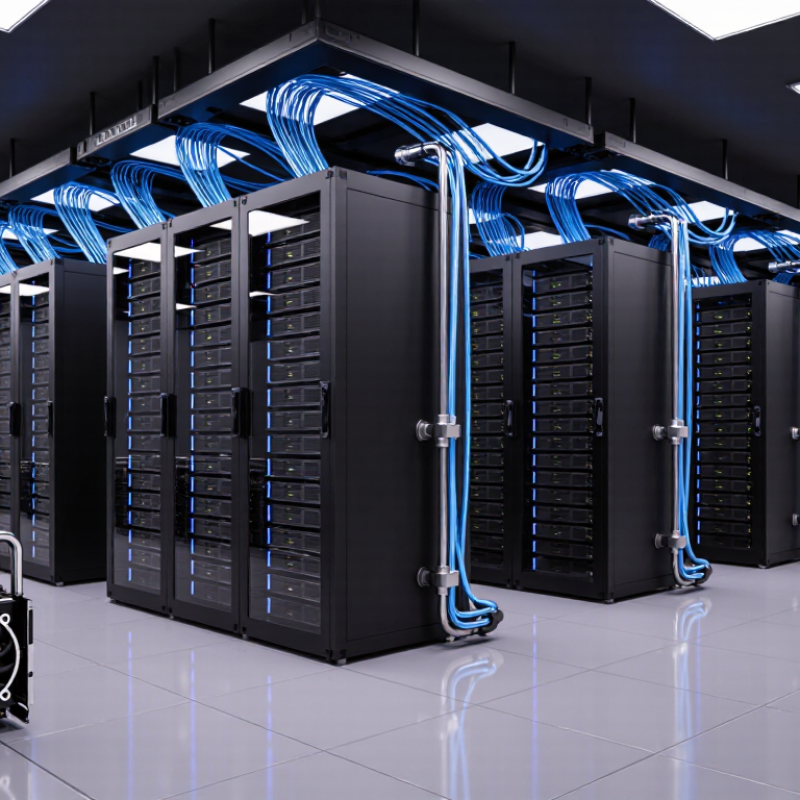
That workload changes what a server room needs. High-speed networking helps reduce delays between machines, while dense memory supports large model operations. More powerful systems also create more heat, so cooling and reliable electricity become practical constraints. A full rack is not just a row of boxes; it is a concentrated load on a facility.
Demand does not mean every planned system will ship on schedule. Accelerator availability, construction timelines, power access, and budgets can all slow deployments. Some buyers may also discover that their workloads need fewer servers than expected. That possibility deserves attention. Shipment growth signals investment, but it cannot show whether each new system will be used efficiently or deliver a clear return. Forecasts can shift as procurement plans meet real-world limits.
A brand-neutral comparison framework for evaluating AI training server manufacturers. The entries below are industry benchmarks and selection criteria, not a ranked list of companies.
| # | Evaluation Dimension | Fact or Benchmark | Why It Matters | Reference |
|---|---|---|---|---|
| 1 | Market demand outlook | TrendForce forecast 41.5% year-over-year growth in AI-server shipments for 2024. | Rapid forecast growth increases the importance of manufacturing capacity, component sourcing and delivery planning. | TrendForce, 2024 AI-server shipment forecast. |
| 2 | Accelerator configuration | Compare the number and supported configurations of accelerators per server; there is no single universal accelerator count for all AI workloads. | Training performance depends on matching compute density to model size, workload and available power and cooling. | Compare each manufacturer’s published system specifications and workload validation results. |
| 3 | High-speed expansion | PCI Express 5.0 operates at 32 GT/s per lane. | High-speed expansion connectivity is relevant to accelerator, storage and network adapter configurations. | PCI-SIG, PCI Express 5.0 specification. |
| 4 | Network capacity | 400 Gigabit Ethernet is standardized in IEEE 802.3bs. | High-throughput links can support data movement between training servers and within larger compute clusters. | IEEE 802.3bs Ethernet standard. |
| 5 | Rack compatibility | The 19-inch rack is a standardized equipment-mounting format; 19 inches equals 482.6 mm. | Confirming rack, rail and service-clearance compatibility helps avoid deployment delays in existing facilities. | IEC 60297 series; EIA-310 rack standards. |
| 6 | Thermal design | ASHRAE’s recommended inlet-temperature range for applicable data-processing equipment classes A1–A4 is 18–27°C. | Ask manufacturers to document inlet conditions, airflow requirements and supported cooling options for the proposed configuration. | ASHRAE, Thermal Guidelines for Data Processing Environments. |
| 7 | Memory support | The JEDEC DDR5 SDRAM standard includes data rates up to 6,400 MT/s. | Memory capacity, bandwidth and supported module configurations affect data feeding and workload performance. | JEDEC JESD79-5 series, DDR5 SDRAM standard. |
| 8 | Power efficiency measurement | Power Usage Effectiveness (PUE) is defined as total data-center energy divided by IT-equipment energy; a value of 1.0 is the theoretical minimum. | Server power draw contributes to facility energy use, so compare measured system consumption under equivalent workloads. | The Green Grid, PUE definition and measurement guidance. |
| 9 | Storage connectivity | NVMe is a host-controller interface and storage protocol designed for non-volatile memory over PCI Express. | Check the supported drive count, capacity, hot-swap design and storage configuration for the intended training-data workflow. | NVM Express specifications. |
| 10 | Validation and serviceability | There is no single industry-wide pass score for AI-server validation; testing should document workload, configuration, duration and measured results. | Request reproducible performance, thermal and reliability test records, plus clear maintenance procedures and parts availability. | Evaluate against the buyer’s workload and deployment requirements. |
Note: The 41.5% figure is a 2024 shipment-growth forecast, not a confirmed final shipment result. Manufacturer suitability should be assessed using the exact system configuration and deployment requirements.
A useful comparison of ten AI training server manufacturers should focus on more than advertised GPU counts. GPU nodes need balanced processors, memory, and high-speed networking to keep large training jobs moving. Ask how a system performs under sustained load, not just during a brief benchmark. Heat matters. In a dense rack, poor airflow can throttle accelerators and raise operating costs. Check power limits, cooling options, and the space needed for cables and service access.
Rack systems reveal how well a manufacturer handles integration. Look for tested compatibility across nodes, switches, power distribution, and management software. Ask who diagnoses faults when several components are involved, and how replacement parts are supplied. A polished specification sheet can hide awkward service details. I would want a clear answer before deployment. Integration quality is often visible in the small things: labeled cables, consistent firmware, and a rack that technicians can maintain without disrupting nearby systems.
Tips: Request a reference configuration and workload-based test results. Confirm support hours, spare-part access, and upgrade paths. Compare total rack power, not only server power. Leave room for growth; the first layout may not be the final one.
A useful comparison of AI training server manufacturers begins with comparable MLPerf Training results. Numbers matter. Context matters more. Check the workload, accelerator count, precision, software stack, and submission type behind each score. A result from a large cluster cannot be fairly compared with a smaller system without considering scale. Review time to train and scaling efficiency, not peak throughput alone. Ask whether the tested configuration matches the server being offered. Independent benchmark records help, but they do not replace testing your own models.
Power and cooling data show what benchmark scores leave out. Compare measured wall power during training, then estimate energy per completed run. Check whether measurements include networking and cooling overhead; boundaries differ. Ask for inlet temperature, cooling method, and rack-level power requirements. A faster system may draw more power or require liquid cooling and facility upgrades. Small details matter. Request data for both sustained load and idle operation, with the measurement method clearly stated. Some vendor sheets leave gaps, and that should prompt questions, not assumptions. I would also test a representative workload before buying; benchmark results rarely tell the whole story.
Pairing 80 GB of HBM3 memory with a 700 W thermal design power (TDP) affects server design from the board outward. At full rated power, one accelerator draws 0.7 kWh over an hour. Eight devices represent 5.6 kW before host processors, memory, fans, and networking are counted. That is substantial. The 80 GB capacity can reduce transfers to system memory, but it cannot eliminate workload or utilization limits. Test power draw with the intended models; TDP is not a constant measure of everyday consumption.
Facility limits matter just as much. The International Energy Agency’s Electricity 2024 report estimates that data centers consumed about 460 TWh globally in 2022, with demand potentially exceeding 1,000 TWh by 2026. Uptime Institute’s 2024 Global Data Center Survey describes power availability and capacity as continuing operational concerns. These figures make rack density and cooling part of procurement planning, not afterthoughts. Air cooling may suit some configurations, while dense racks can require carefully modeled airflow or liquid cooling. Cooling matters, too. A specification sheet cannot predict a site’s inlet temperature, workload peaks, or redundancy needs. Sizing for peak power may overshoot; sizing for averages can leave too little headroom.
The forecast predicts 41.5% growth as companies seek more computing capacity. Larger model training and rising user demand drive investment. It is still a forecast, not a guarantee.
Accelerator supply, construction schedules, electricity access, and budgets can delay installations. Some buyers may need fewer servers than expected. Plans change.
Training can keep accelerators busy for days while large datasets move between processors and storage. Fast networking helps reduce delays between machines.
That capacity can reduce transfers to system memory during some workloads. It does not remove limits from workload size or utilization.
One accelerator at its rated power uses 0.7 kWh in an hour. Eight would draw 5.6 kW, before other server components are counted.
No. Actual draw depends on workload and utilization. Test the intended models; a specification sheet cannot answer everything.
Several high-power accelerators concentrate heat and electrical demand in one rack. Air cooling may suit some setups, while denser racks may need modeled airflow or liquid cooling.
Consider peak demand, average use, cooling, and redundancy. Planning only for peaks can overshoot, while relying on averages may leave too little headroom.
No. Growth signals investment, but not efficient use or clear returns. It is worth checking whether each system will serve real workloads.
AI training servers are purpose-built systems that combine high-memory accelerators, fast data paths, and scalable networking to handle demanding machine-learning workloads. This overview explains how GPU memory capacity, bandwidth, node design, and rack-level integration shape performance, and why rising AI adoption is driving rapid growth in server shipments. It also considers the engineering impact of accelerators with specifications such as 80 GB of HBM3 memory and a 700 W thermal design power, which require careful attention to power delivery and cooling.
Rather than ranking suppliers by claims alone, the article outlines how buyers can assess an ai training server manufacturer through training benchmarks, energy efficiency, cooling solutions, and the ability to integrate systems at different scales. Comparing these factors helps organizations identify systems suited to their workload, infrastructure, and operating constraints, while balancing compute performance with deployment complexity and long-term efficiency.